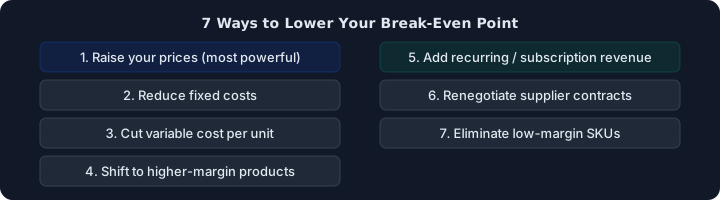
How to Lower Your Break-Even Point: 7 Proven Strategies
Learn 7 actionable strategies to lower your break-even point, from raising prices and cutting variable costs to shifting your product mix.
Why Lowering Your Break-Even Is a Strategic Priority
Your break-even point determines how much risk your business carries. A high break-even means you need a lot of sales volume before you make any profit, and that leaves you vulnerable when sales dip, costs rise, or competition increases.
Lowering your break-even doesn't just mean lower costs. It means improving your margin structure so each sale contributes more, or finding ways to cover fixed costs with fewer sales. The result: more resilience, faster path to profit, and less need to chase volume at all costs.
Here are seven strategies that actually work, with real numbers.
Strategy 1: Raise Your Prices (The Most Powerful Lever)
No strategy lowers break-even faster than a price increase. Because your variable costs don't change, every dollar of price increase goes directly to contribution margin.
Example:
Raise price 10% to $33:
A 10% price increase cut the break-even by 14% without changing a single operational process. The key question is how much volume you'll lose from the increase. In most markets with genuine product differentiation, a 10% price increase causes less than 10% volume loss, meaning you come out ahead on both break-even and total profit.
Read our full analysis in [how pricing strategy affects your break-even point](/blog/pricing-strategy-break-even).
Strategy 2: Reduce Fixed Costs
Fixed costs are the numerator in the break-even formula. Cut them, and break-even drops proportionally.
High-impact areas:
Example: Cutting fixed costs from $18,000 to $15,000:
A $3,000/month reduction in fixed costs saved 167 break-even units.
Strategy 3: Cut Variable Cost Per Unit
Every dollar saved in variable cost is a dollar added to contribution margin, and those savings apply to every unit sold.
Tactics:
Strategy 4: Shift to Higher-Margin Products
If you sell multiple products, not all of them contribute equally to covering your fixed costs. Products with high contribution margins get you to break-even faster per unit sold.
Run a contribution margin analysis by product line. You might find that your most popular product has the worst margin. It generates volume but doesn't efficiently cover fixed costs. Your less-popular premium line might have 3x the margin.
The fix isn't necessarily to kill the low-margin product. It's to stop treating all sales equally. Give your highest-margin products better placement, more marketing budget, and more sales effort. See our [contribution margin guide](/blog/contribution-margin-guide) for how to calculate and compare margins across products.
Strategy 5: Add Recurring Revenue
Recurring revenue (subscriptions, retainers, maintenance contracts) is particularly valuable because it converts unpredictable variable revenue into something closer to guaranteed income, effectively turning revenue certainty into a reduction in required break-even volume.
If a service business converts 20% of one-time clients to $200/month retainers, and 50 clients sign up, that's $10,000/month in predictable revenue. Against $18,000 in fixed costs, that's $10,000 you no longer need to "win" from new sales. Your effective break-even for new business drops dramatically.
SaaS companies are the obvious example, but service businesses, maintenance companies, consultants, and even product companies (consumables subscriptions) can build this model.
Strategy 6: Renegotiate Supplier Contracts
Many businesses accept supplier pricing passively after the initial agreement, but supplier relationships are ongoing negotiations, and there are legitimate reasons to reopen the conversation:
A 5% reduction in a major component cost can shift your variable cost per unit meaningfully. For a business where variable cost is $20/unit, a 5% reduction saves $1/unit. At 1,500 units/month, that's $1,500/month, enough to lower break-even by roughly 83 units.
Strategy 7: Eliminate Low-Margin SKUs and Services
Product and service proliferation is one of the most common hidden contributors to high break-even. Every product you offer has administrative overhead, inventory carrying costs, complexity costs, and customer service load, even if it's not reflected in your variable cost calculation.
Eliminating your bottom 20% of products by contribution margin often reduces operational complexity without meaningful revenue impact, while cutting effective variable costs and the fixed cost burden of managing that complexity.
Start with an 80/20 analysis: which 20% of products generate 80% of your contribution margin? Ruthlessly question everything outside that core. Some low-margin products serve customer retention or complement high-margin ones, those have strategic value. Products that exist by inertia should be cut.
Putting It All Together
The best approach is to combine multiple strategies for compound impact. A business that:
1. Raises prices 8% (+$2.40 CM)
2. Renegotiates one supplier contract (−$1.00 variable cost)
3. Eliminates one $1,500/month software subscription (−$1,500 fixed cost)
…from a base of 1,000 break-even units might see:
A 23% break-even reduction through three achievable changes. Use our [break-even calculator](/break-even-point-calculator) to model the combined impact of your specific scenarios.
To learn how to calculate your starting point accurately before applying these strategies, see our [guide to calculating break-even point](/blog/how-to-calculate-break-even-point) and our [guide on avoiding common break-even analysis mistakes](/blog/break-even-mistakes).
Related Articles
Ready to calculate your break-even point?
Use our free calculator to find your break-even units, revenue, and contribution margin instantly.
Use the Calculator →Break Even Point Calculator Team
We build free, accurate financial calculators for business owners and finance professionals. Our articles follow standard cost-volume-profit (CVP) accounting methodology, verified against sources including Harvard Business Review, Investopedia, and the U.S. Small Business Administration.