7 Break-Even Analysis Mistakes That Cost Businesses Money
Avoid these common break-even analysis errors that lead to bad pricing decisions and inaccurate profit projections. With correction strategies.
Most Break-Even Calculations Are Wrong
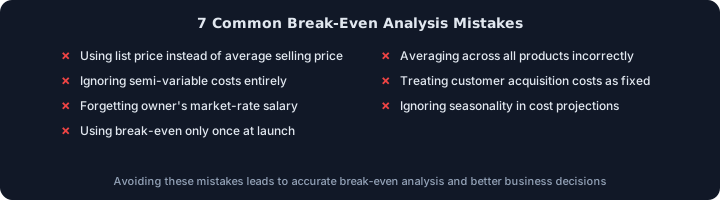
That's not cynical. It's just accurate. Most business owners who do run break-even analysis make at least one of these seven mistakes, often producing break-even projections that are off by 20–40%. The result: prices that aren't high enough, cost structures that don't get scrutinized, and surprises when profitability doesn't materialize.
Break-even analysis is only as useful as the accuracy of its inputs. Here are the mistakes to fix, and what to do instead.
Mistake 1: Using List Price Instead of Average Selling Price
The mistake: You plug in your full retail or list price, ignoring that a significant percentage of sales happen at discounts, promotions, coupons, negotiated bulk pricing, early-bird offers.
The impact: If 30% of your sales are at a 15% discount, your effective average selling price is:
(0.70 × $100) + (0.30 × $85) = $70 + $25.50 = $95.50, not $100.
At $100: CM = $100 − $40 = $60. Break-even = $30,000 ÷ $60 = 500 units.
At $95.50: CM = $95.50 − $40 = $55.50. Break-even = $30,000 ÷ $55.50 = 541 units.
You've underestimated your break-even by 41 units. At scale, this adds up to real losses.
The fix: Track your actual average selling price from invoices or your POS system. Run break-even analysis on the real blended price, not the theoretical list price.
Mistake 2: Ignoring or Misclassifying Semi-Variable Costs
The mistake: Costs with both fixed and variable components get thrown entirely into one bucket. A delivery driver's base salary goes to fixed; their per-delivery mileage reimbursement goes nowhere.
The impact: If $2,000/month in semi-variable costs is misclassified, your fixed costs or variable costs per unit are off, producing an inaccurate break-even.
The fix: Split semi-variable costs using the high-low method:
Or simply estimate: "If I had zero sales this month, what would this cost still be?" That's the fixed component. The rest is variable.
Mistake 3: Forgetting the Owner's Market-Rate Salary
The mistake: The owner's time and compensation isn't included in fixed costs because the owner doesn't "pay themselves" formally, or pays themselves only when there's surplus cash.
The impact: The business appears to break even, but it only does so because the owner is working for free or below market rate. A business that's "profitable" only because the owner earns below minimum wage isn't actually viable.
The fix: Estimate a market-rate salary for your role (what would you pay someone to do your job?). Include this as a fixed cost in your break-even analysis. If the business can't cover that salary plus all other costs, the business model needs work.
This isn't an arbitrary choice. It's standard in business valuation. The U.S. Small Business Administration [SBA.gov](https://www.sba.gov) recommends normalizing owner compensation when evaluating business financials.
Mistake 4: Running Break-Even Analysis Only Once at Launch
The mistake: You calculate break-even before opening and never revisit it. Costs change, prices change, sales mix changes.
The impact: Your original break-even of 400 units becomes irrelevant when you hire a second employee, move to a bigger space, or your supplier raises prices 15%. You're flying blind because your model is stale.
The fix: Run break-even analysis quarterly at minimum. Immediately recalculate any time:
Use our [break-even calculator](/break-even-point-calculator) for quick recalculation. It takes under two minutes to update your numbers.
Mistake 5: Incorrect Multi-Product Averaging
The mistake: When selling multiple products, you use a simple average of contribution margins rather than a volume-weighted average.
Example: Two products, each with 50% of sales by count:
Simple average CM: ($20 + $10) ÷ 2 = $15
Volume-weighted CM: (0.70 × $20) + (0.30 × $10) = $14 + $3 = $17
The difference is $2/unit. Across 1,000 units monthly, that's $2,000 in contribution margin you've miscalculated. Your break-even will be off accordingly.
The fix: Weight contribution margins by actual sales volume (units or revenue), not a simple count of product lines. Re-check this calculation any time your sales mix shifts materially. See our guide on [contribution margin analysis](/blog/contribution-margin-guide) for the full methodology.
Mistake 6: Treating Customer Acquisition Cost (CAC) as a Fixed Cost
The mistake: Marketing and advertising costs get lumped into fixed costs, but if your marketing spend scales with customer acquisition, pay-per-click ads, affiliate commissions, sales rep commissions. It's actually variable.
The impact: Paid acquisition costs are effectively a variable cost tied to each sale. A $12 CAC on a product with a $15 CM per unit means your real contribution margin is $3, not $15. Your break-even is dramatically higher than your fixed-cost-only analysis suggests.
The fix: For every sale that comes through a paid acquisition channel, include the acquisition cost in your variable cost per unit for that channel. Run a blended analysis across organic and paid acquisition if you have both.
This is especially critical for e-commerce and SaaS businesses where CAC is a major expense.
Mistake 7: Ignoring Seasonality
The mistake: Break-even analysis uses annual average costs divided by 12, ignoring that some months have materially higher fixed or variable costs.
The impact: A retail store might have $8,000/month in fixed costs during lean months but $14,000 in November and December (seasonal staff, holiday marketing, extra inventory financing). Using $8,000 to plan for Q4 means you'll hit December thinking you're well above break-even when you're actually underwater.
The fix: Build a monthly break-even model, not just an annual average. Each month should reflect its actual cost structure. Identify your highest-cost months and verify your pricing and volume strategy covers those peaks. For businesses with extreme seasonality, consider whether your pricing during peak season adequately subsidizes off-peak fixed costs.
Putting It Together: Clean Break-Even Analysis
Avoiding these mistakes doesn't require complex modeling. It requires honest inputs:
Then plug those accurate numbers into our [break-even point calculator](/break-even-point-calculator) and you'll have a reliable foundation for every pricing and cost decision.
For more on improving your numbers once you have an accurate analysis, read [how to lower your break-even point](/blog/lower-break-even-point).
Related Articles
Ready to calculate your break-even point?
Use our free calculator to find your break-even units, revenue, and contribution margin instantly.
Use the Calculator →Break Even Point Calculator Team
We build free, accurate financial calculators for business owners and finance professionals. Our articles follow standard cost-volume-profit (CVP) accounting methodology, verified against sources including Harvard Business Review, Investopedia, and the U.S. Small Business Administration.