How Pricing Strategy Affects Your Break-Even Point
Discover how raising or lowering prices changes your break-even point. Learn why pricing decisions are often more powerful than cutting costs.
The Price-Break-Even Connection Nobody Talks About Enough
Most business owners think about pricing from one direction: what will the market bear? But pricing has a second, equally important dimension, how does this price affect my break-even point and the risk profile of my business?
A 10% price increase can lower your break-even by 20–30%. A 10% price cut can push it up by the same amount. These aren't theoretical. They're built into the math of contribution margin. Understanding this relationship changes how you think about every pricing decision.
How Price Changes Affect Contribution Margin
Your break-even formula is: Fixed Costs ÷ (Selling Price − Variable Cost Per Unit)
When you change the selling price, you change the denominator, and changes to the denominator have outsized effects when the margin is thin.
Baseline scenario:
Raise price by 10% to $33:
Cut price by 10% to $27:
A 10% price cut increased the break-even by 18%. If current sales are 1,100 units, that price cut just pushed you from profitable (above break-even by 100 units) to unprofitable (100 units below break-even). That's a catastrophic outcome for what seemed like a modest pricing move.
Use our [break-even calculator](/break-even-point-calculator) to model these scenarios before making pricing changes.
Price vs. Cost Reduction: Which Lever Is More Powerful?
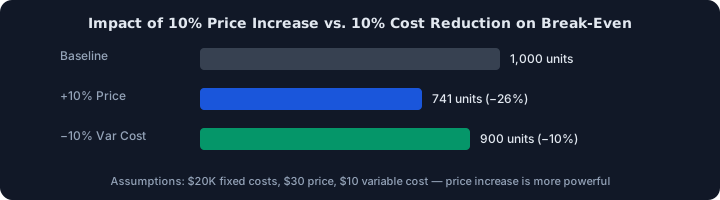
Compare the impact of a $3 price increase versus a $3 reduction in variable costs on the same baseline (BEP of 1,000 units):
They're mathematically equivalent at first glance, but the execution difficulty differs dramatically. Raising your price by $3 (10%) might mean nothing to a customer who sees your product as premium, and it requires no operational change. Reducing variable costs by $3 per unit might mean renegotiating supplier contracts, changing materials, or investing in process efficiency.
For most businesses, pricing is the higher-impact, lower-effort option. The question is whether your market allows it.
Pricing Strategies and Their Break-Even Implications
Cost-Plus Pricing
Set your price by adding a markup to your cost: Price = Variable Cost + (Fixed Cost Per Unit) + Profit Margin.
The problem: this approach ignores what customers will actually pay. If your markup produces a price below market rates, you're leaving money on the table. If it's above market rates, you won't sell enough to break even.
Cost-plus gives you a floor (you know you're not selling below cost) but not a ceiling. Use it as a sanity check, not a primary pricing method.
Value-Based Pricing
Set your price based on the value you deliver to the customer, not your costs. A business consulting service that saves a client $50,000 can charge $10,000, not because it cost $10,000 to deliver, but because it created $50,000 in value.
Value-based pricing typically produces much higher contribution margins than cost-plus, which dramatically lowers your break-even and increases profitability. If your market supports it, it's almost always the right approach.
Penetration Pricing
Set a low initial price to gain market share, intending to raise prices later. This is a legitimate strategy, but understand the break-even implications: your low-price period will have a much higher break-even point, requiring higher volume to avoid losses.
Before committing to penetration pricing, model the break-even at your introductory price and verify you can realistically hit that volume. Many businesses underestimate how much volume a low price requires. Check our [break-even analysis guide](/blog/how-to-calculate-break-even-point) for the formula.
Price Discrimination
Charge different prices to different customer segments: premium pricing for urgent buyers, discounts for price-sensitive segments, annual vs. monthly billing options.
This doesn't change your per-unit variable cost, but it changes your blended average selling price. If 30% of customers pay full price ($30) and 70% use a discount ($24), your blended average is 0.30 × $30 + 0.70 × $24 = $9 + $16.80 = $25.80.
Blended CM = $25.80 − $10 = $15.80. Break-even rises to $20,000 ÷ $15.80 = 1,266 units.
Run the calculation on your actual pricing mix, not just your list price.
The Pricing-Volume Trade-Off
Raising prices usually reduces volume somewhat (demand elasticity). The break-even analysis tells you exactly how much volume you can lose and still come out ahead.
If you raise price by 10% ($30 → $33) and your break-even drops from 1,000 to 870 units, you can afford to lose up to 130 customers (13% of volume) and still maintain the same profitability. If your price increase causes less than 13% volume loss, you're better off with the higher price.
This is how you calculate the maximum acceptable volume loss from a price increase:
Volume Loss Threshold = (Old Units − New Break-Even Units) ÷ Old Units
In our example: (1,000 − 870) ÷ 1,000 = 13%
Research suggests that price elasticity in most non-commodity markets is less severe than business owners fear. A 10% price increase rarely causes 13% volume loss when the product has genuine differentiation.
When to Raise Prices
Clear signals that you should raise prices:
Clear signals that price might be the problem (not an opportunity):
For a framework on reducing your break-even through a combination of pricing and cost management, see our guide on [how to lower your break-even point](/blog/lower-break-even-point).
Discounts and Their Hidden Break-Even Cost
Every discount is a price cut with immediate break-even consequences. A 20% discount on a product with a 40% contribution margin ratio effectively doubles the break-even required to cover the loss.
Before offering a discount, ask: how many additional units do I need to sell at this lower price to generate the same total contribution margin as selling at full price?
Breakeven Volume for a Discount:
Volume discounts make sense when the incremental volume materializes. Loyalty discounts make sense when they improve retention economics. Panic discounts rarely make sense. Know the math before you slash the price.
Related Articles
Ready to calculate your break-even point?
Use our free calculator to find your break-even units, revenue, and contribution margin instantly.
Use the Calculator →Break Even Point Calculator Team
We build free, accurate financial calculators for business owners and finance professionals. Our articles follow standard cost-volume-profit (CVP) accounting methodology, verified against sources including Harvard Business Review, Investopedia, and the U.S. Small Business Administration.