Break-Even Analysis for Startups: What Investors Need to See
How startup founders use break-even analysis to validate business models, plan runway, and present credible financials to investors.
Why Break-Even Is the First Question Investors Ask
Before an investor asks about your TAM, your competitive moat, or your go-to-market strategy, they're running a mental break-even calculation. They want to know: at what point does this business stop burning cash and start generating it? How plausible is that point given current market conditions?
Break-even analysis isn't just an academic exercise for startups. It's the foundation of financial credibility. Founders who can clearly articulate their break-even scenario, the assumptions behind it, and how sensitive it is to changes in key variables demonstrate a level of financial literacy that significantly affects investor confidence.
The Startup Break-Even Challenge: Pre-Revenue Uncertainty
Most financial frameworks work on historical data. Break-even analysis for pre-revenue startups works entirely on estimates. The challenge is making those estimates credible, grounded in market research, comparable data, and honest assumptions rather than optimism.
For early-stage startups, break-even analysis serves three purposes:
1. Validating the business model before committing significant resources
2. Calculating runway requirements, how much capital do you need to reach break-even?
3. Setting operational targets, what revenue and unit milestones must you hit, and by when?
Step 1: Model Your Fixed Cost Structure
Startup fixed costs tend to be dominated by people and infrastructure. Build your model around realistic hiring plans.
Typical seed-stage startup (tech):
At $30,000/month in fixed costs, you need $360,000/year in contribution margin to break even. Build your model around this anchor number.
Step 2: Establish Variable Cost Per Unit
For software startups, variable costs are often very low per user:
A SaaS product with $50/month subscription and $3 variable cost per user has a $47 contribution margin (94% CM ratio). At $30,000 monthly fixed costs: break-even = $30,000 ÷ $47 = 638 users.
For marketplace or e-commerce startups with inventory, variable costs are higher. Calculate this honestly, don't model at software margins if your business has physical product costs.
Step 3: Set a Realistic Selling Price
Pricing for startups deserves careful thought. The temptation to price low to gain early customers can permanently anchor your pricing and undermine your break-even economics.
Before finalizing prices, ask:
Use our [break-even calculator](/break-even-point-calculator) to test different price points before committing.
Step 4: Calculate Break-Even and Runway
With your inputs defined:
Example SaaS startup:
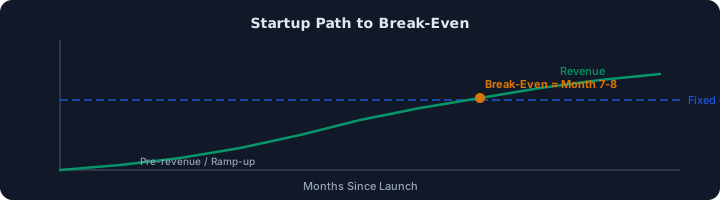
Now translate that to runway planning. If you raise $500,000 at $32,000/month burn, you have roughly 15 months of runway. If you can reach 427 users in 12 months, you'll break even with 3 months cushion. If it realistically takes 18 months, you'll need another funding round before profitability.
This analysis tells you exactly how much to raise. You need enough runway to reach break-even plus a meaningful buffer (typically 4–6 months) for the unexpected.
Sensitivity Analysis: What Investors Actually Want to See
Sophisticated investors don't want a single break-even scenario. They want to understand the sensitivity of your model to key assumptions. Present three scenarios:
Bear case: Lower pricing (10–15% below plan), higher churn than modeled, slower sales cycle
Base case: Your central projection with stated assumptions
Bull case: Higher pricing, faster growth, lower-than-expected variable costs
For each scenario, calculate:
If your bear case breaks even at 800 users but your total addressable market is only 1,000 qualified buyers, that's a red flag to address. If your bull case shows break-even at 250 users and you already have 180 letters of intent, that's a compelling story.
Common Startup Break-Even Mistakes
Modeling at full-price with zero churn: Real SaaS businesses have 2–8% monthly churn and offer trials. Your effective ARR per customer is lower than the list price implies.
Excluding founder salaries: If founders take minimal salary during the early stage, that's fine, but disclose it clearly. Investors know the business will eventually need to compensate leadership at market rates.
Ignoring customer acquisition cost: CAC is effectively a variable cost tied to each new customer. If it costs $300 in marketing to acquire a $79/month customer, you need 4 months of payments before that customer even covers acquisition cost. Include CAC in your variable cost for new customers during the payback period.
Setting break-even at revenue rather than contribution margin: Revenue is not the right threshold. You reach operational break-even when total contribution margin equals total fixed costs, not when revenue equals total costs (which includes variable costs and thus overstates the required revenue).
Presenting Break-Even to Investors
Keep it clean and specific:
1. State your monthly fixed costs and the assumptions behind them
2. State your contribution margin per unit and its components
3. Show break-even in units (customers, transactions) and in monthly revenue
4. Show your time-to-break-even based on your growth model
5. Show sensitivity to the two or three most critical assumptions (price, churn, CAC)
Investors respect founders who know their break-even cold and can discuss how different scenarios affect it. It signals financial discipline and operational awareness, qualities that correlate with capital efficiency.
For the underlying calculation methodology, use our [break-even point calculator](/break-even-point-calculator) or review the [full step-by-step guide to calculating break-even point](/blog/how-to-calculate-break-even-point). For SaaS-specific analysis including MRR and churn, see our [SaaS break-even analysis guide](/blog/saas-break-even-analysis).
Related Articles
Ready to calculate your break-even point?
Use our free calculator to find your break-even units, revenue, and contribution margin instantly.
Use the Calculator →Break Even Point Calculator Team
We build free, accurate financial calculators for business owners and finance professionals. Our articles follow standard cost-volume-profit (CVP) accounting methodology, verified against sources including Harvard Business Review, Investopedia, and the U.S. Small Business Administration.