SaaS Break-Even Analysis: MRR, Churn, and CAC Explained
How to calculate break-even for SaaS businesses using MRR, churn rate, and customer acquisition cost. Includes worked examples and key metrics.
Why SaaS Break-Even Works Differently
SaaS businesses have unusual unit economics compared to most businesses. Variable costs per user are very low (often under 10% of revenue). Fixed costs are dominated by engineering, product, sales, and customer success headcount, and revenue is recurring, once you acquire a customer, they pay monthly until they churn.
This structure means the standard break-even formula works, but it needs to account for a few SaaS-specific realities: churn reduces your effective revenue per customer over time, CAC is a real per-customer cost that must be recovered, and MRR is the unit of measurement rather than "units sold."
SaaS Break-Even Fundamentals
The core break-even formula applies directly:
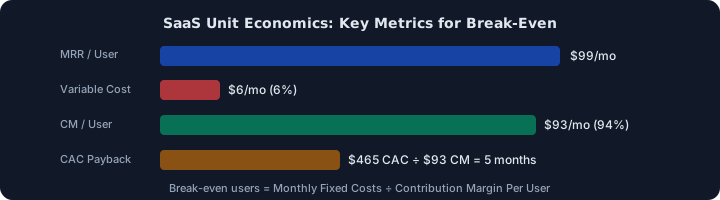
Break-Even Users = Monthly Fixed Costs ÷ Contribution Margin Per User Per Month
Where: Contribution Margin = Monthly Subscription Price − Variable Costs Per User
Variable costs in SaaS include:
What's NOT variable in SaaS:
Example:
With $45,000/month in fixed costs: Break-even = $45,000 ÷ $93 = 484 active users
Use our [break-even calculator](/break-even-point-calculator) to calculate your specific SaaS break-even using these inputs.
Factoring in Churn: The Most Important Adjustment
Monthly churn rate is the percentage of users who cancel each month. If you have 500 users and 2% churn monthly, you lose 10 users per month before accounting for new acquisitions.
Churn has two effects on break-even analysis:
1. It increases the gross number of users you need to acquire to maintain any given net active user count
2. It shortens the effective lifetime of each customer, reducing lifetime value (LTV)
Gross vs. Net MRR Growth:
To reach break-even at 484 users with 2% monthly churn, you need to maintain 484 active users continuously, which means acquiring users fast enough to offset the ~10/month who leave.
Monthly users needed to acquire (at steady-state):
If you want to hold 484 users with 2% churn: 484 × 0.02 = ~10 new users/month just to stay flat.
To grow toward break-even from 200 users: you need enough new users per month to close the gap while replacing churn. If you acquire 35 new users and lose 4 (2% of 200), net growth is 31/month, roughly 9 months to reach 484.
Customer Acquisition Cost (CAC) and Payback Period
CAC is the total cost of acquiring one customer. For SaaS, this includes:
If you spend $15,000/month on sales and marketing and acquire 30 new customers: CAC = $15,000 ÷ 30 = $500/customer
CAC Payback Period = CAC ÷ Contribution Margin Per Month
$500 ÷ $93 = 5.4 months
This means each new customer takes 5.4 months of subscription payments before you've recovered the cost of acquiring them. During that period, new customers contribute nothing to covering your fixed costs. They're in "debt payback" mode.
This is why rapidly growing SaaS companies burn cash even with good unit economics: the upfront CAC must be paid immediately, while the CM payback happens over months.
The LTV:CAC Ratio
LTV (customer lifetime value) = Contribution Margin Per Month ÷ Monthly Churn Rate
With $93 CM/month and 2% monthly churn: LTV = $93 ÷ 0.02 = $4,650 per customer
LTV:CAC ratio = $4,650 ÷ $500 = 9.3x
A ratio above 3x is generally considered healthy for SaaS. Above 5x suggests you may be underinvesting in growth. The benchmark varies by segment, but 3–5x is the standard bar for Series A investors.
SaaS Break-Even Including CAC
To model break-even with realistic customer acquisition economics, add CAC as a per-customer cost amortized over the payback period.
In the simplified model, during the CAC payback period (5.4 months), each user's net contribution to fixed costs is:
Monthly CM − (CAC ÷ Payback Period) = $93 − ($500 ÷ 5.4) = $93 − $92.59 = $0.41/month
This illustrates that a company acquiring at the rate where CAC payback = 1 CM month is almost exactly at unit-economics break-even on new customers. They contribute nearly nothing to fixed costs during payback.
After payback: each customer contributes $93/month to fixed cost coverage. The first 484 post-payback-period users cover fixed costs. The company achieves true operational break-even once it has enough users who've passed their payback period.
Key SaaS Break-Even Benchmarks
Industry benchmarks to compare against:
Improving SaaS Unit Economics
To lower your SaaS break-even:
For general strategies applicable to any business, see our guide on [how to lower your break-even point](/blog/lower-break-even-point), and for the core break-even analysis methodology, start with our [complete break-even calculation guide](/blog/how-to-calculate-break-even-point).
Related Articles
Ready to calculate your break-even point?
Use our free calculator to find your break-even units, revenue, and contribution margin instantly.
Use the Calculator →Break Even Point Calculator Team
We build free, accurate financial calculators for business owners and finance professionals. Our articles follow standard cost-volume-profit (CVP) accounting methodology, verified against sources including Harvard Business Review, Investopedia, and the U.S. Small Business Administration.