Restaurant Break-Even Analysis: A Complete Guide
Calculate your restaurant break-even point with real examples. Covers per night, food cost ratios, and how to use CVP analysis in food service.
Why Restaurants Need Break-Even Analysis More Than Most
Restaurant profit margins typically run 3–9%. That means for every $100 of revenue, you might keep $3–$9 after paying all costs. There's almost no other industry with margins that thin operating at that scale of complexity.
At those margins, knowing your break-even point isn't optional. It's how you stay in business. A slow week that would be a minor inconvenience for most businesses can put a restaurant into loss territory for the entire month. Restaurant break-even analysis tells you exactly how many covers (or how much revenue) you need every day, week, and month before you make a dollar.
Restaurant Costs: Fixed vs. Variable
Unlike many businesses, restaurants have significant costs in both categories. Getting them right is the foundation of your break-even calculation.
Fixed Costs in a Restaurant
A 60-seat casual dining restaurant might have $12,000–$20,000 in monthly fixed costs. A quick-service café might sit closer to $6,000–$10,000. A fine dining establishment can exceed $40,000/month.
Variable Costs in a Restaurant
What to Use as "Units" in a Restaurant
For break-even analysis, you have two main options:
1. Covers (customers served): Use your average check size as the selling price and your average variable cost per cover (primarily food cost) as variable cost
2. Revenue dollars: Use total revenue vs. total variable costs expressed as percentages
Both approaches work. Covers are more intuitive for day-to-day operations ("we need 80 covers tonight"); revenue works better for financial modeling.
Step-by-Step Restaurant Break-Even Calculation
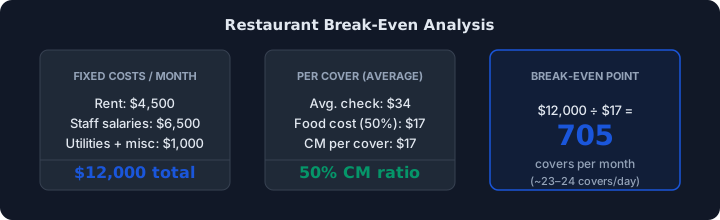
Let's work through a real example for a 45-seat neighborhood restaurant.
Fixed Costs (Monthly):
Variable Costs (Per Cover):
Contribution Margin: $38.00 − $18.61 = $19.39/cover
CM Ratio: $19.39 ÷ $38.00 = 51%
Break-Even Covers: $13,500 ÷ $19.39 = 696 covers/month
Break-Even Revenue: $13,500 ÷ 0.51 = $26,471/month
Daily break-even (26 operating days/month): 27 covers per day or $1,018 in daily revenue
Open for dinner only, 4 hours per night: that's roughly 7 covers per hour to break even. Run two seatings at 45 seats each and you need about 30% occupancy per seating. That's genuinely achievable, which is the goal of this exercise.
Use our [break-even point calculator](/break-even-point-calculator) to model your specific numbers.
Food Cost: The Most Important Variable
Food cost percentage is the ratio of food cost to food revenue. It's the biggest variable you can actively manage.
Target ranges by concept:
A 5-percentage-point improvement in food cost has a dramatic impact. If you're doing $40,000/month in revenue at 35% food cost, cutting to 30% saves $2,000/month in variable costs, lowering your break-even by about 103 covers at a $19.39 CM.
Ways to improve food cost percentage:
Beverage and Bar Revenue
Alcoholic beverages typically carry a contribution margin of 70–80%, far higher than food. If your restaurant has a significant bar program, this meaningfully lowers your overall break-even because beverages require minimal additional fixed cost.
Factor your beverage mix into your analysis by calculating a blended average check and variable cost across food and drink. A restaurant doing $38 average check with 30% beverage mix at $25 average drink price and 23% beverage cost has a different (better) contribution margin than the food-only calculation suggests.
If you're struggling to reach break-even, a stronger beverage program, cocktails, wine pairings, craft beer selection, can be a faster route to profitability than cutting food cost.
Labor: Fixed or Variable?
This is the gray area in restaurant cost analysis. Kitchen staff on salary are fixed. The dishwasher working 4 hours tonight is variable. Most restaurants have a blend.
For planning purposes, separate labor into:
To reduce your break-even, variable labor management is critical. Overstaffing on slow nights, paying four servers when two would suffice, directly raises your variable cost per cover.
Third-Party Delivery: A Break-Even Warning
Delivery platform commissions of 15–30% of order value can effectively destroy your margin if you haven't priced for them. A $30 delivery order with a 25% commission leaves you with $22.50 in revenue. If your variable food cost is $10.50, your contribution margin drops to $12, compared to $18+ for the same dine-in order.
Either price your delivery menu 25–30% higher than your dine-in menu (which most platforms allow), treat delivery as a separate revenue stream with its own break-even, or cut delivery platforms that don't generate net contribution to fixed cost coverage after commissions.
Daily and Weekly Targets
The most actionable version of break-even analysis for restaurant managers is translating monthly numbers to daily and shift-level targets.
If your break-even is 696 covers/month on a 26-day schedule:
Track actual vs. target nightly. When you're consistently below break-even covers, you can intervene early, adjust staffing, push promotions, contact regulars, rather than discovering at month-end that you lost money again.
For more on optimizing your break-even, read our guide on [how to lower your break-even point](/blog/lower-break-even-point) and [how pricing strategy affects profitability](/blog/pricing-strategy-break-even).
Related Articles
Ready to calculate your break-even point?
Use our free calculator to find your break-even units, revenue, and contribution margin instantly.
Use the Calculator →Break Even Point Calculator Team
We build free, accurate financial calculators for business owners and finance professionals. Our articles follow standard cost-volume-profit (CVP) accounting methodology, verified against sources including Harvard Business Review, Investopedia, and the U.S. Small Business Administration.