Fixed vs Variable Costs: The Complete Business Guide
Understand the difference between fixed and variable costs, why it matters for profitability, and how to classify your business expenses correctly.
Why the Fixed/Variable Distinction Matters
Every business expense falls into one of two categories: fixed or variable. Getting this classification right isn't an accounting formality. It's the foundation of pricing strategy, break-even analysis, and profit planning. Misclassify a major expense, and your break-even projections could be off by hundreds of units or thousands of dollars.
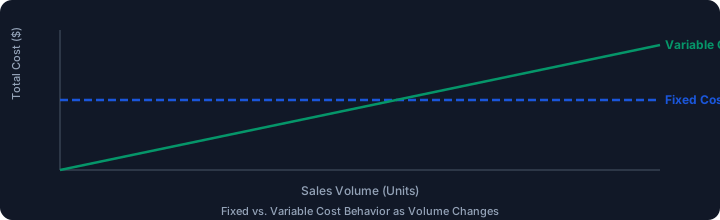
Fixed costs and variable costs behave completely differently as your sales volume changes. That difference is what makes cost-volume-profit analysis work, and why understanding it is non-negotiable for any serious business owner.
What Are Fixed Costs?
Fixed costs stay constant over a given period regardless of how much you produce or sell. Whether you sell 50 units or 5,000, your rent doesn't change. Your full-time manager's salary doesn't change. Your annual insurance premium doesn't change.
More precisely, fixed costs are fixed within a relevant range, the normal operating capacity of your business. If you expand to a much larger facility, rent jumps, but within normal operations, these costs are stable.
Typical fixed costs:
The key characteristic: fixed costs spread across more units as you sell more. A $5,000/month lease divided across 500 units costs $10/unit. Divided across 1,000 units, it costs $5/unit. That's why scale improves profitability, fixed costs get diluted.
Step-Down Fixed Costs
Some fixed costs increase in steps rather than continuously. You might need a second warehouse when you hit 10,000 units per month, adding a discrete jump in fixed costs. These are called step-fixed or semi-fixed costs. Plan for them when projecting growth, because each step-up changes your break-even point.
What Are Variable Costs?
Variable costs move in direct proportion to your sales or production volume. Produce one more unit, incur one more unit of variable cost. Double your production, double your variable costs.
Typical variable costs:
The key characteristic: variable costs per unit stay constant regardless of volume. Your packaging costs $0.40 per unit whether you ship 100 or 100,000. The total variable cost changes; the per-unit rate doesn't.
Why Variable Cost Per Unit Matters So Much
Your variable cost per unit, combined with your selling price, determines your contribution margin, and your contribution margin is what drives break-even analysis. A small change in variable cost per unit ripples through to every unit you sell. Reduce variable costs by $1 per unit and sell 2,000 units per month. That's $2,000 more toward fixed costs and profit every month, without changing anything else.
Use our [break-even point calculator](/break-even-point-calculator) to see exactly how changes in your variable cost per unit affect your break-even threshold.
Semi-Variable Costs: The Tricky Middle Ground
Some expenses have both a fixed base and a variable component. These are semi-variable or mixed costs.
Common examples:
For break-even analysis, split semi-variable costs using the high-low method or regression analysis. At minimum, estimate the fixed component (what you'd pay with zero sales) and the variable component (the per-unit rate above that base). Assign each piece to its respective category.
If precise separation isn't worth the effort, assign semi-variable costs to the category that best represents their dominant behavior. A utility bill that's 80% base charge and 20% usage-driven is better classified as fixed for planning purposes.
Real-World Classification Examples
Let's walk through some common business scenarios.
Restaurant: $12,000/Month in Costs
E-Commerce Business: $6,500/Month
How to Use This in Your Break-Even Analysis
Once you've classified all your costs:
1. Sum all fixed costs to get your monthly fixed cost total
2. Sum all variable costs per unit to get your variable cost per unit
3. Plug both into our [break-even calculator](/break-even-point-calculator) along with your selling price
Your break-even units = Fixed Costs ÷ (Selling Price − Variable Cost Per Unit)
The contribution margin, selling price minus variable cost, is what every sale contributes toward covering fixed costs. See our full guide on [understanding contribution margin](/blog/contribution-margin-guide) to go deeper on how to use this number.
How Fixed vs. Variable Costs Affect Pricing Strategy
High fixed costs relative to variable costs mean you have high operating leverage. Sell above break-even and profits grow quickly; sell below it and losses mount fast. Software companies have extremely high operating leverage: near-zero variable cost per user, massive fixed costs. Physical goods businesses typically have lower operating leverage.
Understanding your cost structure helps you price strategically. If your fixed costs are high and variable costs are low, you can sometimes accept lower prices on high-volume deals because each unit still contributes meaningfully. If variable costs are high, pricing discipline matters more because every discount hits harder.
Learn how to apply this thinking in our guide on [how pricing strategy affects your break-even point](/blog/pricing-strategy-break-even).
Common Classification Mistakes
Mistake 1: Treating owner salary as a fixed cost when it varies
Many small business owners adjust their own pay based on cash flow. If your take-home fluctuates with business performance, it's closer to a distribution (profit withdrawal) than a true fixed cost. For accurate break-even analysis, either include a market-rate salary for your role as a fixed cost, or exclude it entirely and understand that any "profit" must cover your pay.
Mistake 2: Ignoring depreciation
Equipment depreciates in value over time. Depreciation is a real cost that reduces taxable income and should appear in your break-even analysis as a fixed cost, even though it doesn't affect cash flow directly.
Mistake 3: Classifying all labor as fixed
Hourly staff who get sent home when it's slow are variable labor. Salaried staff who work regardless of volume are fixed. The distinction matters: if you can genuinely cut labor costs when sales drop, treat that portion as variable.
Getting this right is worth the effort. Accurate cost classification means accurate break-even analysis, which means better pricing decisions. Run your numbers through our [break-even point calculator](/break-even-point-calculator) to see how your cost structure affects profitability.
Related Articles
Ready to calculate your break-even point?
Use our free calculator to find your break-even units, revenue, and contribution margin instantly.
Use the Calculator →Break Even Point Calculator Team
We build free, accurate financial calculators for business owners and finance professionals. Our articles follow standard cost-volume-profit (CVP) accounting methodology, verified against sources including Harvard Business Review, Investopedia, and the U.S. Small Business Administration.