E-Commerce Break-Even Analysis: Costs, Margins & Targets
Calculate break-even for your e-commerce store including product cost, shipping, platform fees, and CAC. With real examples and order targets.
E-Commerce Break-Even Is More Complex Than It Looks
Running an e-commerce business means dealing with a variable cost stack that most business owners underestimate. It's not just the product cost, by the time you add fulfillment, platform fees, payment processing, and customer acquisition, your contribution margin can be dramatically lower than your gross markup suggests.
Getting the break-even calculation right for e-commerce requires accounting for all these per-order costs accurately. Miss one, and your break-even point could be 40–60% higher than you think.
The E-Commerce Variable Cost Stack
Unlike a service business where variable costs are minimal, e-commerce has multiple layers of cost per order. Here's the complete stack:
Product/COGS
Your product cost, what you paid the manufacturer, wholesaler, or supplier per unit. Include:
Typically: 30–50% of selling price for consumer goods, 20–35% for proprietary/branded products.
Fulfillment and Shipping
Getting the order from your warehouse to the customer:
If you offer free shipping, every penny of shipping cost is a pure variable cost eroding your margin. "Free shipping" is never actually free. It just moves the cost from the customer to your contribution margin.
Platform and Transaction Fees
For break-even analysis, treat percentage-based platform fees as variable costs per order.
Customer Acquisition Cost (CAC)
If any portion of your sales comes through paid advertising, the ad spend is a real variable cost. Calculate:
CAC (paid channel) = Ad Spend ÷ Orders from that Channel
Include this in your variable cost analysis for orders originating from paid channels. For organic/repeat customer orders, CAC may be near zero.
Blended CAC example: 60% of orders from paid traffic at $8 CAC, 40% from email/organic at $0.50 CAC.
Blended CAC = (0.60 × $8) + (0.40 × $0.50) = $4.80 + $0.20 = $5.00/order
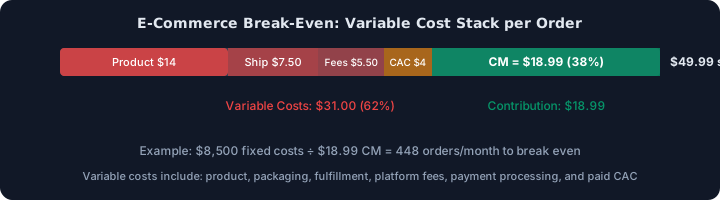
Complete Break-Even Calculation: E-Commerce Example
Let's work through a real scenario for a skincare brand:
Product: Moisturizer, selling price $49.99
Variable Costs Per Order:
Contribution Margin: $49.99 − $30.65 = $19.34 (38.7% CM ratio)
Monthly Fixed Costs:
Break-Even Orders: $10,500 ÷ $19.34 = 543 orders/month
Break-Even Revenue: 543 × $49.99 = $27,145/month
That's roughly 18 orders per day, achievable for an established brand but demanding for a new one.
Run your own numbers through our [break-even calculator](/break-even-point-calculator) to see exactly where you stand.
The Free Shipping Trap
"Free shipping" is one of the most expensive marketing decisions in e-commerce, and most brands don't fully account for its break-even impact.
If you ship 543 orders/month at $7.50 each, free shipping costs $4,072.50/month. That's effectively an increase to fixed costs (or a reduction in contribution margin). Your break-even just got harder.
Alternatives to blanket free shipping:
Inventory Carrying Costs and Working Capital
E-commerce break-even analysis needs to account for inventory risk. Inventory you've purchased but haven't sold is cash tied up that's not contributing to covering fixed costs.
The inventory carrying cost, the cost of holding unsold inventory, is typically 20–30% of inventory value per year. This includes:
For break-even purposes, estimate carrying costs as a fixed overhead allocation rather than a per-unit variable, but be aware: a business with $60,000 in slow-moving inventory is burning $12,000–$18,000/year just to hold it.
Seasonality and E-Commerce Break-Even
Most e-commerce businesses have dramatic seasonality. A gift product might do 60% of annual revenue in Q4. A garden brand might do 70% in Q1–Q2.
Your break-even calculation needs to account for this. Fixed costs don't pause in your slow months, but revenue might drop 70–80% from peak. Build a monthly break-even model and verify:
Amazon's FBA program has seasonal cost implications too, Q4 FBA storage fees spike significantly, affecting variable costs during the exact period when volume is highest.
Improving E-Commerce Contribution Margin
Raise average order value (AOV): Free shipping thresholds, bundles, and upsells increase revenue without proportional variable cost increases. A $20 AOV increase on $30.65 variable costs improves CM from 38.7% to 46.8%.
Optimize packaging: Dimensional weight shipping is calculated on the size of the box, not just the product weight. Tight-fitting packaging cuts both material cost and shipping cost.
Improve return rates: Each percentage point reduction in return rate saves ~$0.80/order in amortized return handling. Training customers via better product descriptions, size guides, and photos reduces mismatch returns.
Build repeat customer base: Loyal customers who return organically have near-zero CAC. If 40% of your orders come from email subscribers at $0.50 blended CAC vs. new customers at $8+, your overall contribution margin is meaningfully higher than a pure new-customer model.
For a deeper dive on contribution margin improvement strategies, read our [contribution margin guide](/blog/contribution-margin-guide). For overall break-even methodology, see [how to calculate your break-even point](/blog/how-to-calculate-break-even-point).
Related Articles
Ready to calculate your break-even point?
Use our free calculator to find your break-even units, revenue, and contribution margin instantly.
Use the Calculator →Break Even Point Calculator Team
We build free, accurate financial calculators for business owners and finance professionals. Our articles follow standard cost-volume-profit (CVP) accounting methodology, verified against sources including Harvard Business Review, Investopedia, and the U.S. Small Business Administration.